

The Difference between Freedom of Action and Freedom of Will
When Arthur Schopenhauer said, “A man can do as he will, but not will as he will,” he was making a crucial distinction between freedom of action and freedom of will.
Let’s break down the two parts to this statement:
1. “A man can do as he will”: you can act according to your desires. If you will to pick up a glass, and you’re physically able, you can do it. This is freedom of action.
2. “But not will as he will”: you can’t choose your will itself. You didn’t choose what you want or why you want it. Your desires, motives, character, and temperament were shaped by forces beyond your conscious control—your biology, upbringing, circumstances, and unconscious drives. This means your will is not free.
The Deeper Implication:
.gif)
Schopenhauer, born on February 22, 1788, believed that the will is the fundamental driving force behind everything in nature—including human behavior—but that it is irrational, impersonal, and not something we choose.
In this view, you experience yourself as choosing, but you’re really being moved by will—like a puppet that thinks it’s the puppeteer. The idea of free will is an illusion. You don’t pick your motivations; you simply act them out.
Example: you might say, “I chose to be generous in that situation.” Schopenhauer would respond to you: “Yes, but you didn’t choose to have a generous nature in the first place.”
In modern terms, you have agency within constraints, but you didn’t choose the constraints—your genes, instincts, early experiences, and so forth. This idea influenced later thinkers like Nietzsche and Freud and still resonates today in debates around determinism and the unconscious.
Where Astrology Comes In:
Astrology starts from a very similar premise to Schopenhauer’s: you didn’t choose your birth chart—i.e., your specific planetary configurations, signs, aspects, or house placements.
These represent the raw psychological wiring and motivational blueprints you came in with. You can become aware of them and work with them—but you don’t “will” them into being.
Example: you might be born with Mars opposing Pluto. You feel intense drives, power struggles, maybe rage. You can act on those impulses however you choose (do as you will)—through competition, leadership, shadow work, and so forth. But you didn’t choose to have that kind of will (not will as you will). That Mars-Pluto tension is a given.
In this sense, the natal chart is a portrait of the will you didn’t choose that you’re working with. It is the blueprint of the different universal urges inside you, and:
- their relative strength to each other,
- their harmonious or discordant natures,
- their agendas (their zodiacal sign placements), and
- the areas of your life where they will express themselves (their house placements in your chart).
How Evolutionary Astrology Takes it Even Further :
You may have chosen this pattern at a soul level (i.e., from a pre-incarnational perspective), but you in this lifetime didn’t choose it consciously. The chart represents your current karmic curriculum.
.gif)
Carl Jung famously said: “Until you make the unconscious conscious, it will direct your life and you will call it fate.”
This echoes Schopenhauer, 100 years later. Jung recognized that our wills—our deep drives—are shaped by unconscious forces: shadow material, complexes, archetypes.
Examples: a man may “will” to marry someone cold and distant over and over again—not realizing he’s acting out a mother complex. A woman may “choose” self-sacrifice repeatedly—not realizing it’s a shadow projection of an unconscious belief about self-worth.
In both cases, they can do as they will (freedom of action). But they cannot will what they will—until the unconscious is integrated. So healing, from a Jungian point of view, involves becoming more conscious of your will—and therefore more truly free.
The Synthesis: the Chart is the Will before Consciousness
Think of your natal chart as a kind of Schopenhauerian will-map: it reveals what your soul wants, what it’s working on, and what kinds of drives and desires shape your experience.
Jungian work and astrology both help you see this structure, reflect on it, and gradually evolve from compulsion to conscious participation.
You still can’t “will as you will”—but you can form a relationship with the will you’re made of.
We created the Lila app to be a modern-day tool to make the unconscious more conscious. That’s why we wrote the app’s content the way we have, with the Healthy expressions and the Out-of-Balance expressions on the different universal urges that express through the planets.
Back to our friend Mars, who bestows upon us the aggressive urges that are alive and kicking inside every sentient being on Earth:
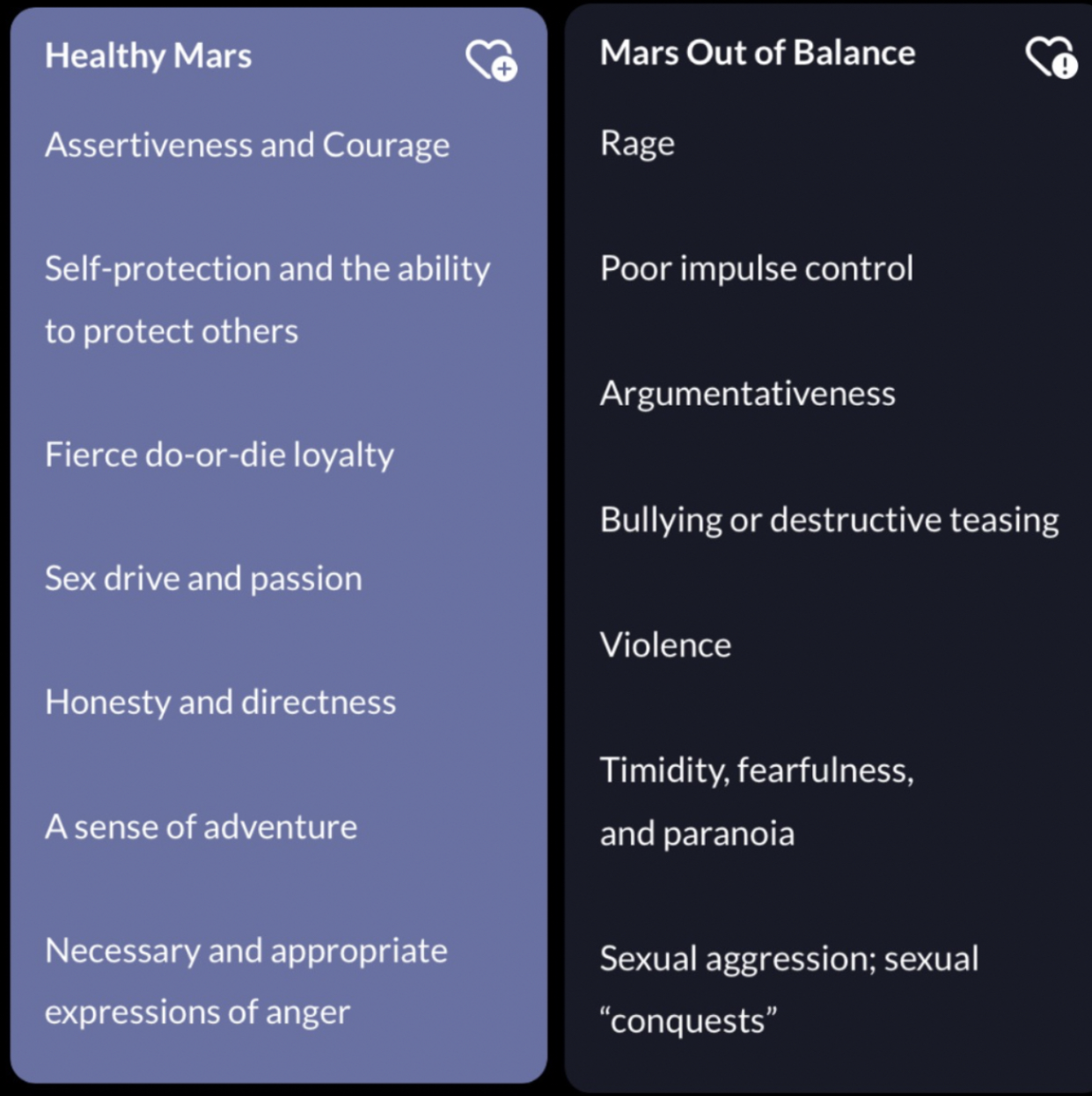
These comparisons help us all to become skillful at recognizing when we are expressing an energy unconsciously, and how to alchemize it into a more conscious, productive expression that will be valued and appreciated by the world around us.
Mastery is recognizing this in the moment and making a deliberate energetic shift in the now-moment: embodying more of the puppeteer than the puppet.
To read more about the conscious and unconscious expressions of the universal energies operating inside you, open the Lila app and tap on the My Chart section. To download the Lila app for iOS click here and for Android click here.
Post written and published by Linnea Miron on February 22, 2026.

.svg)

